

High dealership lead response time directly results in lost revenue, as delayed replies cause UK car buyers to abandon inquiries in favor of more responsive competitors. Dealerships can bridge this sales gap by adopting automated communication tools and setting internal performance benchmarks to ensure all leads are contacted within minutes.
Most UK sales managers know the frustration of watching a warm lead turn cold while their team prioritizes administrative tasks over immediate outreach. This delay is more than a missed opportunity; it is a direct drain on your dealership net profit. In a market where the modern car buyer expects instant gratification, a thirty minute delay might as well be a week. This article examines the psychology of today's buyer and the hidden costs of a sluggish sales floor. You will learn how to shift from excuses to rigorous daily standards by implementing Performance Cards and a 90 day system for sales consistency. We provide the blueprint to eliminate response lag and ensure your team treats every digital inquiry with the urgency it deserves.
Why Dealership Lead Response Time is the Ultimate Profit Killer

Every hour a lead sits untouched in a CRM represents a decaying return on investment. In the UK, the digital car-buying journey rarely aligns with traditional showroom hours. Data indicates a significant volume of inquiries land at 8 PM, while the buyer is browsing from their sofa. If your sales team does not engage until 10 AM the following morning, you have already conceded the competitive advantage to a more agile operator. This delay is the ultimate profit killer because it transforms a warm prospect into a cold statistic.
We define dealership lead response time not as the moment an automated email is triggered, but as the precise interval between a customer inquiry and a meaningful, personal contact. The industry standard often stretches into several hours or even days, masked by common excuses regarding showroom floor traffic. Conversely, a performance system for sales teams demands a response time of under 15 minutes. This is not just a marginal improvement; it is a fundamental shift in daily output that separates market leaders from those merely surviving.
When a dealership operates with a lag, they are not just losing a single unit sale. They are actively destroying their marketing ROI. You are paying for leads that your current process is designed to fail. At Reset 90, we implement 90-day systems that treat response time as a non-negotiable metric. Without a rigorous standard for speed, your advertising budget is effectively subsidizing your competitors' growth. Speed is the primary currency that matters in the first phase of the sales funnel.
The Psychology of the Modern UK Car Buyer
Modern UK buyers rarely inquire with just one business. By the time a lead lands on a Saturday afternoon, that prospect has likely submitted three or four similar inquiries via third-party marketplaces or direct websites. The dealership that secures the first meaningful interaction wins a psychological first place position in the buyer’s mind. This is not merely about being first; it is about establishing professional dominance and trust before the buyer’s attention fragments.
This urgency is driven by intent decay, a phenomenon where a buyer's emotional drive to purchase drops off sharply after the first hour of their inquiry. In the UK market, consumer expectations have shifted away from aggressive sales tactics toward a demand for transparency and efficiency. A rapid, professional response signals that your dealership is competent and respectful of the buyer's time. When your dealership lead response time exceeds that crucial one hour window, you are no longer selling to a hot prospect; you are fighting to re-engage a cooling psychological state. By utilizing a performance system for sales teams to manage these initial moments, you ensure that peak intent is converted into a scheduled appointment rather than a lost opportunity. Failure to act during this window allows the buyer’s focus to drift back to your competitors.
Hidden Costs, Beyond the Lost Sale
The financial impact of a poor dealership lead response time extends far beyond the missed margin of a single vehicle. When a sales department operates with a lag, the entire business model begins to leak capital. First, there is the direct inflation of your Cost Per Lead (CPL). If your team only converts one in ten leads due to slow response, but could convert one in five with a faster process, your marketing spend is effectively twice as expensive as it needs to be. You end up buying more leads to mask a broken process; this is a circular strategy for diminishing returns.
Second, slow response times foster staff burnout and high turnover. There is nothing more soul-destroying for an ambitious professional than spending eight hours a day chasing cold leads that were hot three days ago. This creates a toxic feedback loop where the sales team adopts an excuse culture, blaming the quality of the leads rather than the speed of their own execution. A performance system for sales teams eliminates this ambiguity by focusing on what is controllable: the interval between the inquiry and the action.
Finally, there is the localized brand erosion. For dealerships in Leeds and across West Yorkshire, reputation is built on reliability. When a local customer is ignored, they do not just move to the next advert; they share their frustration within the community. Through our 90-day systems, we help dealerships realize that speed is a form of respect. Failing to meet modern response standards sends a message of indifference that can take years to repair in a regional market.
Moving from Excuses to Rigorous Daily Standards

Transitioning from a culture of excuses to one of high performance requires more than just a motivational speech. At Reset 90, we reject the notion that trying harder is a viable growth strategy. Effort is subjective; a performance system for sales teams is objective. When a dealership relies on the individual willpower of a sales executive to prioritize inquiries, it inevitably fails during peak periods or when morale dips. Trying harder is not a plan; it is a reaction to a lack of structure.
To combat this, we implement specific Daily Standards. These are non-negotiable actions that must be completed every day, regardless of showroom footfall or administrative distractions. A standard might be that every new lead is called within ten minutes, or that no executive leaves for the day until the digital lead queue is at zero. By making these actions binary; either they were done or they were not; you remove the ambiguity that allows dealership lead response time to slip. These standards serve as the floor of your performance, ensuring that even on your worst day, your output remains professional.
The primary tool for this transformation is the Sales Journal. Instead of relying solely on a CRM dashboard that can be ignored in the heat of a busy Saturday, the journal requires the sales professional to document the time each lead arrived and the exact time the first meaningful contact occurred. This process turns a vague feeling of being busy into hard, measurable output data. When you audit a journal, you are not looking at intentions; you are looking at the reality of your speed. Within our 90-day systems, this data becomes the foundation for radical accountability, ensuring that high standards become the new baseline for every member of the team.
Using Performance Cards to Eliminate Response Lag
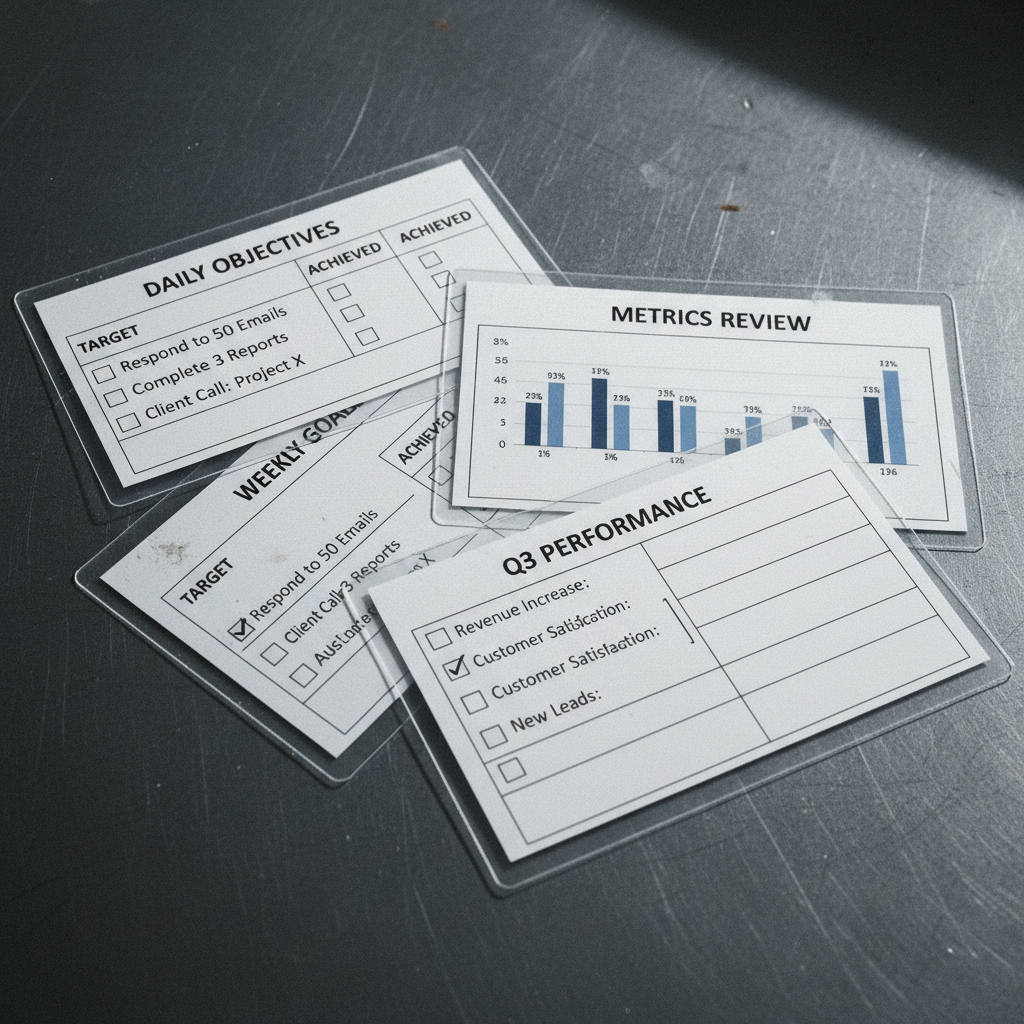
While the Sales Journal captures the data of the past, Performance Cards drive the urgency of the present. Most dealerships suffer from CRM fatigue, where staff only check for notifications when they have a spare moment between walk-ins. This passive approach is what allows dealership lead response time to balloon into hours. Our performance system for sales teams replaces this passivity with a high-stakes ritual. Each inquiry generates a specific Performance Card that demands immediate attention.
This card is more than a reminder; it is a contract of accountability. In a busy showroom, it is easy to tell yourself you will call a digital lead once the floor quietens down. A Performance Card makes that excuse impossible. The task is not considered finished until three criteria are met: the lead is opened, the contact is initiated, and the specific result is logged on the card itself.
By forcing this sequence, you eliminate the common gap where leads are seen but not served. It moves the sales executive from a mindset of administrative data entry to one of active pursuit. When these cards are integrated into our 90-day systems, they create a visible queue of pending tasks that cannot be ignored or buried under the noise of the showroom floor. This ritual ensures that the first step toward a sale is never delayed by a lack of focus.
Implementing a 90 Day System for Sales Consistency

Transforming a dealership's culture from a reactive state to a performance powerhouse requires more than a weekend workshop. It requires a sustained performance system for sales teams executed over a single quarter to embed new habits. Our 90-day systems provide the structure necessary to move from excuse based management to data driven results.
Month 1 focuses on establishing the baseline. You must track your current dealership lead response time with clinical precision. This involves recording the exact minute every inquiry arrives and the moment of first human contact. By stripping away the justifications of a busy showroom floor, you gain an honest look at your current output. Without this baseline, any progress is merely anecdotal. You cannot improve what you are not accurately measuring.
Month 2 moves into implementation. This is where the Reset 90 Performance Cards and Sales Journals become the daily standard. Instead of checking the CRM sporadically, the team follows a mandatory ritual of checking, calling, and logging every lead. This phase is about repetition and breaking the cycle of procrastination. The goal is to make the process of responding to a digital lead as instinctive as greeting a customer who walks onto the forecourt in Leeds.
Month 3 is dedicated to reviewing data and rewarding standard compliant behavior. The sales manager plays a critical role here by leaning in and reviewing the CRM dashboard and journals daily to ensure no lead is left behind. Consistency is solidified by recognizing those who hit the 15 minute response target. This 90 day approach ensures that rapid response becomes an automatic habit rather than a temporary effort, creating a lasting culture of excellence for your sales team.